
TransDrive Grid Couplings
TransDrive Grid Couplings combine strength, efficiency, and user-friendly design, making them an ideal choice for high-performance industrial applications.
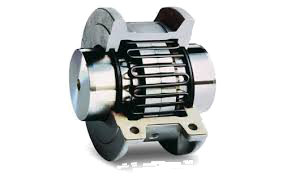
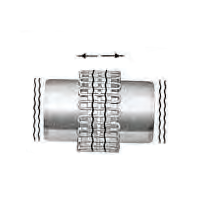
TransDrive Tapered Grid Couplings are compact, high-performance shaft-to-shaft couplings designed to transmit substantial torque in demanding applications. Manufactured from high-strength, hardened alloy steel, they deliver outstanding durability and reliability. The tapered grids feature a trapezoidal cross-section and are heat-treated to achieve spring-like hardness, providing excellent flexibility while effectively absorbing shock and impact loads.
Each grid is enhanced through a precision shot peening process, where high-velocity steel microbeads compress the surface material. This treatment increases the grid’s fatigue strength, builds in reserve capacity, and extends overall service life—ensuring dependable performance in tough operating environments.
Designed with practicality in mind, TransDrive’s removable cover allows quick and easy access to the tapered grids for installation and maintenance. The trapezoidal grid profile fits smoothly into the hub slots without disturbing adjacent equipment, reducing downtime. With its compact design and convenient split cover secured using standard tools, the coupling offers a straightforward and efficient maintenance solution.
Protection against Shaft Misalignment
The tapered grids are free to rock, pivot and float within the hub teeth. This provides generous capacity for misalignment without producing the detrimental side loads on the bearings that are often crated when couplings are misaligned.
Protection against Shock & Vibratory Loads
The Tapered Grid Couplings are able to deflect torsionally when subjected to normal shock or vibratory loads, so they are able to handle changing load conditions. The system truly is a shock absorber for rotary motion, relying on the predictable resilience of the grid for torsional flexibility. The tapered grids “tune” the drive system. Due to their spring hardness, the grids absorb impact by spreading the impact energy over time. The grids can also damp vibration and reduce the peak or shock loads experienced by the rest of the system.
Misalignment Capacity
Accurate alignment results in the maximum life and minimum maintenance for the coupling and the connected machinery. The amount of time for a coupling to reach its maximum operating limits is a function of load, operating speed and lubrication. Maximum operating values listed in the table below are based on the allowable RPM listed on the catalogue. Values listed are based on the use of the specified gaps, use of standard coupling components, standard assemblies and catalogue allowable speeds. Values may be combined for an installation or operating condition. Parallel misalignment is the distance between the centers of each shaft. Angular misalignment is dimension X minus dimension Y as shown in the drawing below. End float is the axial movement of the hubs within the covers as measured from “0” gap. This measure assumes zero angular and zero parallel misalignment.
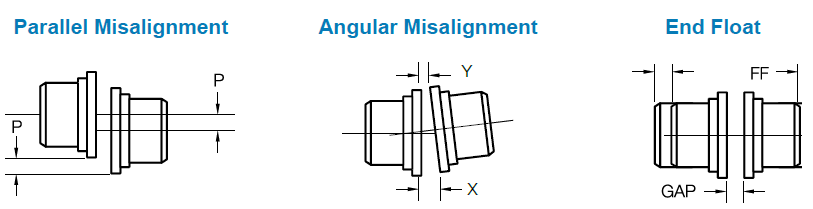
Parallel Misalignment
The movement of the grid in the lubricated grooves accommodates parallel misalignment and permits full functioning of the grid-groove action in damping out shock and vibration
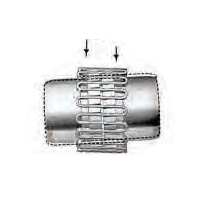
Angular Misalignment
Under angular misalignment, the grid-groove design permits a rocking and sliding action of the lubricated grid and hubs without any loss of power through the resilient grid
End Floating
Unrestrained end float of driving and driven members is permitted because the grid slides freely in the lubricated grooves.
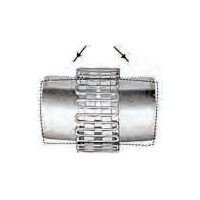
Torsional Flexibility
Torsional flexibility is the advantage of taper grid couplings, providing flexible accommodation to changing load conditions.
Product Specifications
| Coupling Size | Recommended Installation | Operating | Fastener Tightening Torque Values (Nm) | ||
|---|---|---|---|---|---|
| Parallel Offset P Max (mm) | Angular (1/16o) X – Y Max (mm) | Parallel Offset-P Max (mm) | Angular (1/4o) X – Y Max (mm) | ||
| 1020 | 0.15 | 0.08 | 0.3 | 0.25 | 3 |
| 1030 | 0.15 | 0.08 | 0.3 | 0.30 | 3 |
| 1040 | 0.15 | 0.08 | 0.3 | 0.33 | 3 |
| 1050 | 0.20 | 0.10 | 0.4 | 0.41 | 3 |
| 1060 | 0.20 | 0.13 | 0.4 | 0.46 | 3 |
| 1070 | 0.20 | 0.13 | 0.4 | 0.51 | 3 |
| 1080 | 0.20 | 0.15 | 0.4 | 0.61 | 3 |
| 1090 | 0.20 | 0.18 | 0.4 | 0.71 | 3 |
| 1100 | 0.25 | 0.20 | 0.5 | 0.84 | 5 |
| 1110 | 0.25 | 0.23 | 0.5 | 0.91 | 5 |
| 1120 | 0.28 | 0.25 | 0.56 | 1.02 | 6 |
| 1130 | 0.28 | 0.30 | 0.56 | 1.19 | 6 |
| 1140 | 0.28 | 0.33 | 0.56 | 1.35 | 6 |
| 1150 | 0.30 | 0.41 | 0.6 | 1.57 | 6 |
| 1160 | 0.30 | 0.46 | 0.6 | 1.78 | 6 |
| 1170 | 0.30 | 0.51 | 0.6 | 2.01 | 6 |
| 1180 | 0.38 | 0.56 | 0.76 | 2.26 | 6 |
| 1190 | 0.38 | 0.61 | 0.76 | 2.46 | 6 |
| 1200 | 0.38 | 0.69 | 0.76 | 2.72 | 6 |
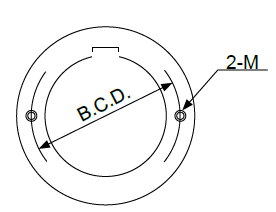
Selection of Puller Holes
| Coupling Size | B.C.D (mm) | Bolt Size |
|---|---|---|
| 1070 | 74 | M8 |
| 1080 | 89.5 | M8 |
| 1090 | 106 | M10 |
| 1100 | 121.5 | M10 |
| 1110 | 136.5 | M10 |
| 1120 | 150.5 | M12 |
| 1130 | 185 | M16 |
| 1140 | 205 | M16 |
| Coupling Size | B.C.D (mm) | bolt Size |
|---|---|---|
| 1150 | 227.5 | M20 |
| 1160 | 260 | M20 |
| 1170 | 306 | M24 |
| 1180 | 341 | M30 |
| 1190 | 373 | M30 |
| 1200 | 414 | M30 |
| 1210 | 540 | M30 |
| 1220 | 570 | M30 |
Resources